
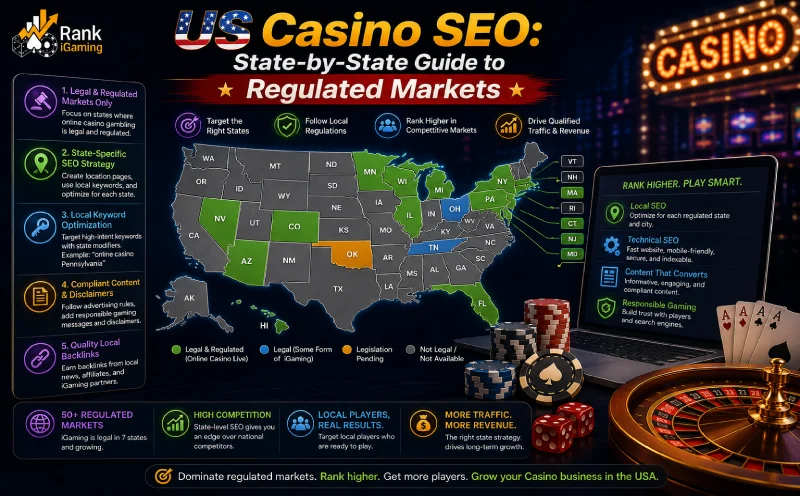
There’s no one strategy for “US casino SEO. Pennsylvania SEO New Jersey SEO Michigan SEO etc. Each state has its own laws on gambling, its own gambling board and its own advertising regulations. For US iGaming SEO, you will need to create a different strategy for each state that you want to target, but all of the technical elements should remain the same.
We compile these state level plans weekly for operators and affiliates. It is contingent upon the state. This guide will tell you what each state allows as of mid 2026 and how to set up a website that targets multiple states without them competing with each other.
Why US iGaming SEO Isn’t One Strategy
This is a legal question, not a technical one. In 2018, the U.S. Supreme Court overturned the federal ban on sports betting (the PASPA ruling). Since then, each state has decided what kind of gambling it allows online. The result is a patchwork of:
- Online sports betting is legal in some 39 states, but each has different licensing and advertising rules.
- As of July 2026, real-money iGaming (online casino games) is legal in only eight states: New Jersey, Pennsylvania, Michigan, West Virginia, Connecticut, Delaware, Rhode Island and Maine (legalized, launch still rolling out).
- The rest range from “active bills in the legislature” (New York, Illinois, Maryland) to “no chance any time soon.”
This patchwork changes everything downstream for SEO:
Your keyword universe changes per state.
“Online casino Michigan” is a real, legal, high intent keyword. “Online casino Texas” will attract searchers you cannot legally serve, and creating content to target this search term can cause regulatory issues.
Your competitors change per state.
Connecticut is a 2 operator market. There are over 20 casino brands in Pennsylvania. NJ SERPs are very competitive and 10 years old. That same keyword difficulty score means very different things from one state to another.
Your compliance rules change per state.
What you can say in an ad or a landing page in one state can be a violation a border away. And that’s why state gambling SEO is a world of its own and why generic national SEO advice goes out the window the moment it touches this niche.
We’ve done the bigger comparison in our guide to the best countries for iGaming SEO in 2026 for a comparison of the US states to international markets. This post is within US borders.
Fully Regulated States Overview
Most Frequently Asked Questions of State Regulated Operators and Affiliates Status as of July 2026 Before acting on any one row, check again. This map is redrawn several times a year.
| State | Online Casino Legal? | Online Sports Betting Legal? | Notable Ad Restrictions |
| New Jersey | Yes (since 2013) | Yes | Mature regulator (DGE); clear bonus term; responsible gambling (RG) messaging required |
| Pennsylvania | Yes | Yes | PGCB pre-approval culture; stringent bonus language guidelines; RG messaging required |
| Michigan | Yes | Yes | MGCB aggressively goes after unlicensed sites; affiliate behavior tracked |
| West Virginia | Yes | Yes | Smaller market, lighter volume, regular RG requirements |
| Connecticut | Yes (tribal duopoly) | Yes | Only two licensed casino operators; very limited affiliate landscape |
| Delaware | Yes (lottery-run, single operator) | Yes | State monopoly model on lottery, minimum commercial advertising market |
| Rhode Island | Yes (single operator) | Yes | Exclusive operator model; limited advertising ecosystem |
| Maine | Legalized (launch rolling out) | Yes | Fact Check: Rules still being settled, tribal-led model, new market |
| New York | Not yet (active bills) | Yes | No misleading “risk-free” style language, which is one of the most stringent sports betting ad rules |
| Illinois | Not yet (under discussion) | Yes | Sports betting ads regulated; tax rates central to iGaming debate |
| Indiana | No | Yes | Sports betting is mature; standard RG and age-targeting rules apply. |
| Virginia | No (2028 earliest) | Yes | Reenactment clause means casino bills must pass twice; sports betting ads regulated |
| Colorado | No | Yes | The state has resisted iGaming thus far, RG messaging needs |
| Arizona | No | Yes | Tribal compact structure; no momentum for iGaming at this time |
| Louisiana | No | Yes (parish by parish) | Betting legal only in participating parishes; geo-precision matters more here |
| Tennessee | No | Yes (online only) | No retail casinos at all, just an online-only sportsbook market with its own regulator |
| Ohio | No | Yes | The regulator has fined operators over ad language and under-21 targeting; be conservative |
Two trends worth highlighting from this table. “First of all, the broad market is sports betting and the narrow market is online casino, so most multi-state strategies are led by sportsbook with casino content layered in in the eight iGaming states. Second, three of the four biggest states in the country (Texas, California, Florida) don’t have legal online casinos at all, so US online casino SEO by state is really a game that is played in a handful of mid-size markets, not a national land grab.
Content & Compliance Differences by State
This is where casino marketing gets real in regulated states. The same article, if it is published for two different states, may need different wording, different disclosures, and different links. These are the key differentiators we bake into briefs:
1. Responsible gambling disclosures.
All regulated states require RG messaging, but the details differ. Some states have an individual helpline number, others use the national number, and the location and prominence of the messaging also differ. If the page is targeting Pennsylvania and has a helpline for some other state, that’s a compliance miss, not just a content error.
2. Self-exclusion program mentions.
States have their own self-exclusion programs and some require licensed brands and their marketing to reference the state program by name, not a generic “gambling problem?” line. State localized, content should identify the correct program.
3. Bonus and promotion wording.
This is the most policed area. Several regulators have penalized operators for using terms such as “risk-free” when the offer was not literally free. US content policy: Clearly state offers, list material terms near the claim, and do not imply guaranteed results. That rule also aligns with this site’s own compliance standard: no winnings guarantees, ever.
4. Age and audience targeting.
The minimum age is 21 in most regulated states and regulators look at whether marketing could appeal to under-21s or college audiences. In states with stricter laws, content strategy avoids anything related to college campuses or youth-coded creatives altogether.
5. Legal claims about availability.
A page cannot say that a product is available in a state where it is not. Online casinos in Ohio have to be presented as legal status information, not as a gateway to play. One of the quickest ways to attract regulator attention as an affiliate is getting this framing wrong.
To get the full picture of compliance’s impact on on-page work in this niche, our casino SEO services page explains how we bake state-level review into every content batch.
Geo-Targeting Techniques for Multi-State Sites
When you’re going after more than one state, site structure is a tactical decision. There is no hreflang for US states (hreflang is for languages and countries, not sub-national regions), so state targeting is done with structure, content and signals instead. Here’s how we do it:
- Sub-directories are better than sub-domains for most websites. Google has stated that both structures can perform well in Search when implemented correctly. Top SEO resources such as Ahrefs and Moz generally advocate for subdirectories as they consolidate authority, make internal linking easier, and simplify long-term SEO management. A structure like site.com/new-jersey/ and site.com/pennsylvania/ maintains all authority on one domain, so every state section can benefit from the backlinks the domain earns. We suggest subdomains only when licensing, platform or technical requirements demand separate properties.
- Make a hub page for each state. An official page for each state: legal status, licensed products, regulator, RG resources for that state, and links to every state specific article. This page is the target for “casino [state]” and “[state] sports betting” queries and the internal linking hub for that market.
- Localize for real, not for show. The thin content trap that hits multi-state sites in quality updates is replacing the state name in a template. Every state page needs to be genuinely unique content. Operators in that state, its tax and launch history, its regulator, local payment quirks and land-based context. If you could switch paragraphs on two of your state pages and no one would notice, they’re not localized.
- Use structured data and consistent NAP-style signals Boldly brand state pages. Keep the state name in titles, H1 tags and URLs. Get at least a few links from state-specificsources (local news, state-specific industry coverage). Without hreflang, Google looks to these signals to ascertain regional relevance.
- Customize geo-targeting to product geofencing. Real play is enforced by geolocation software, not your website. But your content should reflect that reality: state pages for the markets you serve and clear informational framing for the markets you don’t. Sportsbook-led sites that need to juggle many states have additional structural work (event pages, odds feeds, expiring URLs) that we cover separately in our sports betting SEO guide.
Keyword Research Differences by State
US iGaming SEO keyword research is state-specific and the differences are more than most teams expect:
- Competition from branded operators varies widely. Pennsylvania has over 20 casino brands, with branded searches (“BetRivers PA” and “FanDuel Casino PA”) leading volume and the informational middle crowded. In Connecticut you have two operators so the branded landscape is thin and comparison style content has less to compare but generic terms are more winnable.
- Intent changes with market age. Searchers in New Jersey have been legal iGaming for a decade; queries are biased towards comparisons, speed of payment and particular games. Maine is an emerging market, which means it is heavily weighted to “Is it legal?” “When does it launch?” and “How do I sign up?” queries. Same niche, totally different content calendar.
- Keywords on legal status are the entry point in non-iGaming states. In states like Ohio, Texas or New York, the biggest volume of casino-related business is on questions of legality. You can build audience and authority with that content before legalization, but it has to be strictly informational (see compliance section above).
- Sports vs. casino revenue balance shifts by state. Tennessee is a state with no casinos and is an online-only sportsbook state. Casino keywords are a compliance minefield, and sportsbook keywords are the whole market. In Michigan both verticals are live and the keyword sets are almost the same size. Your content budget per state should be based on what is legal in the state.”
- Seasonality is greater in sportsbook states. Sports betting-related keywords spike around the NFL season, March basketball and major events, but casino-related keywords are steadier year-round. Multi-state planning has to budget content and links around those curves, state-by-state.
Common Mistakes When Targeting Multiple US States
The same set of errors we find in just about every multi-state audit:
- One national page that tries to rank everywhere. One “best US online casinos” page can’t out-rank 15 focused state pages in their own states. In almost all regulated SERPs, national-only structures are losing to local competitors.
- Swap names on template state pages. Covered above but it’s the most common failure, so it gets its own line. Quality systems are aware of this pattern, and one thin batch can suppress the entire cluster.
- Breaching content ad rules of every state If you write one set of bonus language for all states, you always run the risk of your most stringent state (think New York or Ohio). Write to the most rigorous applicable standard or localize the wording.
- Free game to be had with unregulated states. The quickest path for an affiliate to lose operator partnerships and attract regulator attention is to send users in non-legal states to play or offshore sites. Non-legal state content should be kept informational.
- Splitting authority between domains or subdomains without any reason. Each property has to earn links in its own right. In a niche where quality links are this expensive, splitting authority is an expensive structural error.
- No intention to change the law. Status Changes in Mid-Year. When a state flips (bills passing in New York or Illinois would create just such a surge), sites with a maintained legal-status hub and a monitoring process will capture the surge. Sites without one scramble in the aftermath.
If you’re also wondering who should manage all this, our checklist on how to choose an iGaming SEO agency has some pointers on how to vet US-market experience specifically.
FAQ
Q: Do I need a different domain for each US state?
A: No, and you can’t most of the time. A single domain with state subdirectories consolidates your power and lets each of the state sections use it. Separate domains or subdomains only make sense if licensing or platform requirements are driving the split.
Q: Is national casino SEO possible in the US?
A: Merely a thin veneer on top of work at the state level. A national hub can capture broad research queries but rankings that produce actual players happen at the state level because legality, competitors and search intent are all state specific.
Q: Which states are best for casino SEO right now?
A: In the online casino space, New Jersey, Pennsylvania, and Michigan are the biggest but also the most competitive. West Virginia and Connecticut are smaller with less competition. Maine is a new opportunity with the launch rolling out. The map is much broader for sportsbook-led approaches, with about 39 states.
Q: Can I create content for states where online casinos aren’t legal yet?
A: Yes, and it can be smart positioning but it has to stay informational: legal status, pending bills and what a regulated launch would look like. It must not imply availability or encourage users to play offshore. Done right, that content becomes a ranking head start the day a state legalizes it.
Q: How is US iGaming SEO different from European markets?
A: Europe is fragmented by country and language and hreflang manages the targeting. In one language, targeting is based on site structure and content signals, as the US is divided by state. US ad enforcement also varies from regulator to regulator, not country to country. Top international markets to compare in our best countries for iGaming SEO guide.
Q: How often do state laws change?
A: A few statuses do change every year. Meanwhile, Maine’s market has been rolling out in 2026 alone, Virginia’s bills stalled with a 2028-at-earliest path and New York, Illinois and Maryland all have active debates. Any state-by-state approach must include a legal-monitoring step in the monthly workflow.
Ready to Map Your State-by-State Opportunity?
Every multi-state strategy we build begins the same way with a free audit that lays out your current state of visibility, state by state, flags compliance risks in your existing content, and exposes where the winnable gaps are for your specific markets.
Get a free audit of your US market →