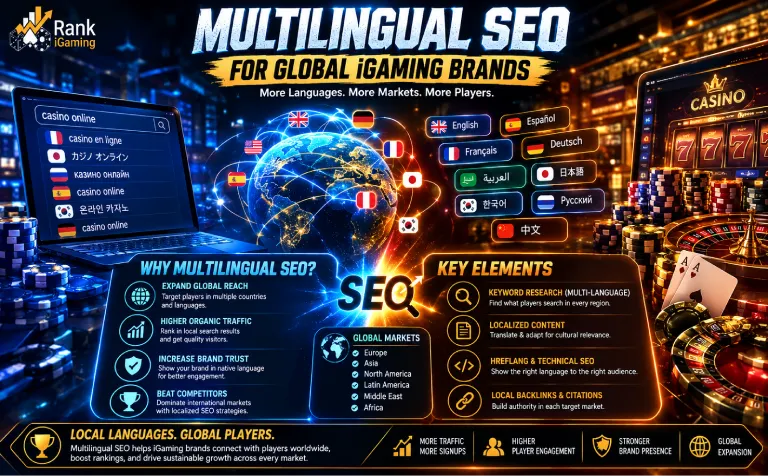
Global iGaming brands rarely operate in one market at a time. A single operator might hold a license in Germany, run affiliate content for the UK, and be contemplating a launch in another regulated state, all at once, all in different languages. Multilingual SEO igaming is what enables that expansion to truly work in search results instead of simply on paper. Get it right and each market finds you in its own language, with content that reads like it was designed for local players. Get it incorrectly and you wind up with duplicate-looking sites, unclear ranks, and, in the worst situations, compliance holes that translation discreetly introduced.
This book covers the strategy behind growing into other language markets, the technical hreflang setup that makes it happen, and the compliance considerations that translation alone can never solve for you.
Why Multilingual SEO Matters for iGaming Brands
Here’s the assumption that trips up a lot of growth plans: that translating your best-performing English page into German or Spanish would yield the same results in the new market. It won’t, because you need more than translation to rank in a new language market. By default, a translated page doesn’t have local relevance and local trust signals it needs.
Google views a German casino page from the perspective of German competition, German search behavior, and German trust expectations, not how it performed in English. A page that ranks because it is clear and authoritative in one market is starting over in another because none of the signals that created that authority (links, engagement, reputation) immediately cross languages.
That’s also why production of content must come before market selection, not afterwards. The nations you’re targeting will determine keyword volume, competition level and even which compliance requirements are in play. If you’re still trying to decide where to expand, rather than how, read our guide to the best countries for iGaming SEO, where we break down how to analyze and prioritize markets, and this piece.
A structural concern worth mentioning early: Many operators expanding into multiple markets at once do not create every language site in-house. A frequent structure is coupling a core team with a white label casino SEO partner to handle execution in new markets without developing a full local team for each one.
Localization vs. Translation: Why the Difference Matters
Translation is the conversion of words from one language to another. Localization changes everything from the whole page, tone and terminology to how compliance is structured for how a market genuinely reads and controls gaming content. For iGaming brands, there are no grey areas there. That’s the entire game.
The risk of losing precisely the elements that make casino information trustworthy and compliant is one-to-one translation. That’s an illustration of that. The language used to describe a wagering restriction, the information expected with a promotion, and even the terms players use when evaluating offers vary each region. Marketing text that reads as standard compliant in English may not be clear, or even compliant, when translated word for word into another regulatory environment.
And the tone shifts, too. A confident, conversational voice can work well for one audience but sound out of place or untrustworthy in a market where players are looking for the more formal, reserved type of gambling content. And local language influences it too at the keyword level: gamers in one nation might search for “online casino” while a nearby market with a different regulatory history seeks a whole new phrase for the same product.
Practical rule for translation of casino content SEO: never use a direct translation as finished content. Treat it as a first draft that a market-fluent reviewer, ideally someone who understands both the language and that market’s gaming legislation, adapts before it goes live.
Hreflang Implementation for Gambling Sites
Hreflang is the technological signal that informs Google on the language and regional version of a page to display to a searcher. Put simply, it’s how you tell search engines “this German page and this English page are the same content, show the right one to the right audience,” and it’s a way you can ensure that the proper search engine finds the right information.
Each page in a multilingual set needs to have a hreflang tag pointing to itself and to all the other language/region variants of that same page. There also needs to be an x-default tag for anyone Google isn’t sure of matching to a specific version. Do this correctly across a large site and it runs in the background silently. Getting it wrong actively messes up which page is displayed.
The 2 faults we encounter regularly in Hreflang gaming site audits:
Return tags missing. Hreflang needs to be reciprocal. If you have an English page, and it links to your German page, then that German page needs to link back to the English page (and all other language versions in the set). Google treats a one-way hreflang tag as invalid and ignores it, silently breaking the entire configuration with no clear error.
Invalid language or region code(s). de implies German language in general. de-DE is German as it’s spoken in Germany precisely which is a huge deal in a niche where German speaking Austria, Switzerland and Germany all have distinct gambling rules. If you use the wrong code or mix language-only and language-region codes on a site inconsistently, you’ll send Google confusing signals about which page goes where.
Validate hreflang after every major site update, not just at launch. It’s the kind of thing that fails softly when templates change, and nobody notices until rankings in a certain market drop quietly.
URL Structure Options for Multilingual Casino Sites
You need a URL structure that allows several languages to be neatly represented before the content or the hreflang. At a high level, comparison of three common techniques:
Subdirectories (example.com/de/, example.com/es/) keep all on one domain. All language versions contribute to the same domain authority which is usually the easiest way to rank a new language section as it’s not starting at zero on link equity. This is the strategy we utilize for our own site: our German iGaming SEO services page lives under the same domain as our English content, structured as a live subfolder. This is a real, tangible and not speculative example of how the strategy works.
The language versions can be better separated via subdomains (de.example.com). Historically, some search engines have treated subdomains as semi-independent. This means it can take longer for authority to pass between language parts than it does with subdirectories, but the gap has closed in recent years. Still, subdomains work when a language version really demands different technical infrastructure or a different hosting setup.
Country-code top-level domains (ccTLDs) (example.de, example.es) provide the greatest signal of local significance, since the domain itself proclaims a market. They come with a significant cost. Each ccTLD grows its own authority independently. You’re really doing separate SEO campaigns per domain, not one cumulative effort. For most multi-market iGaming brands, that cost outweighs the localization benefit unless a single region actually requires domain-level isolation for licensing reasons.
For most operators expanding to a handful of language markets, subdirectories provide the optimum mix of local relevance and shared authority – and that’s exactly the structure we’ve used ourselves.
Region-Specific Compliance in Translated Content
This is the area most people skip and they shouldn’t. When you translate a page, it’s not just the marketing copy that has to be re-verified for the new market. Everything on the page does.
Licensing info. How you’re licensed by the regulator and how that must be disclosed differ market-by-market. A translated page needs to have the correct licensing information for the market it is servicing, not a translation of licensing wording that applies someplace else.
Gambling disclosures. Resources to point to, how prominently they need to be displayed and the precise language authorities anticipate all vary by jurisdiction. One of the biggest compliance holes translation brings is copying a responsible gambling portion without rechecking this against the new market’s rules.
Extra disclaimers. Varying markets have varying rules on wagering requirements, qualifying terms and how prominently the terms are stated next to a bonus offer. A bonus disclaimer that was entirely compliant in the original language may be incomplete or misleading when translated with no compliance re-check.
Instead of guessing, let’s just say it: license rules fluctuate from country to country and change over time, therefore this is general advice and not a replacement for checking the law in each market you enter. Before going live with translated content, get all compliance details reviewed by a licensed professional or the proper regulator.
Avoiding Duplicate Content Across Language Versions
A recurring anxiety when introducing different language versions of similar pages: would Google treat them as duplicate content? If you do it right, no. But the two that prevent it from happening have to work together, not separately.
Hreflang informs Google they are purposely separate language versions of comparable information, targeted for different audiences, not accidental copies. Canonical tags have a different purpose: correcting real duplication in the same language, such as URL parameter variations or a page being at two pathways.
What you should not do: canonicalize your German page to your English page. Which tells Google to treat the German version as a duplicate to be consolidated away. Which is the opposite of what you want for a truly localized page that is meant to rank on its own. Each language version should self-canonicalize (point to itself) and hreflang should deal with the cross-language relationships. Used correctly combined, hreflang plus proper self-referencing canonicals is what keeps a multilingual site from being flattened into duplicate-content confusion.
Building Local Authority in Each Market
Technical setup makes your language versions visible; local authority makes them trustworthy. The two most important techniques per market are:
Building links locally. Links from generic gambling sites from anywhere are less relevant than links from publications in or targeting a particular market. A German page with links from German gaming or sports media creates market-specific authority that a page with only international links never builds, even if the international links are theoretically higher quality on paper.
Local signals and ratings Reviews from players, coverage from local media and mentions from sources that a market’s own audience already trusts establish the kind of confidence search engines are increasingly weighing for YMYL content. This is even more important in gambling than most niches because trust signals are part of what Google’s quality systems are specifically looking for in this category.
Both ways are back to market selection. Which markets are worth this investment depends on the level of competition and the realistic opportunity, which is precisely what our Best Countries for iGaming SEO guide is built to help you evaluate before committing resources to building local authority in a market that may not justify it.
FAQs
Do I need a separate domain for each language?
No. Subdirectories are a typical and effective technique for multilingual iGaming sites, as evidenced by many multilingual sites successfully ranking various language variants under one domain. Separate domains (ccTLDs) can make sense in some instances, but they aren’t a must for ranking in various languages.
Can I just machine-translate my casino content?
Not advised alone. Machine translation can be a valuable beginning point, but compliance and tone nuances often require human localization review before anything publishes. In a YMYL niche like gambling, an unreviewed machine translation risks both a worse reading experience and serious compliance gaps.
Does hreflang directly boost rankings?
No, it does not enhance rankings directly. What it does is assist the correct language version show to the correct audience and avoids duplicate-content misunderstandings between your language versions. I think this is routing infrastructure not a ranking factor.
What’s the biggest mistake brands make when expanding into a new language market?
Treating translation as the finish line instead of the starting point. A translated page still needs local compliance certification, local keyword research, and local link development before it can compete with sites designed natively for that market from day one.
Should hreflang or canonical tags come first when building a multilingual site?
One does not substitute for the other, both are needed. First, set self-referencing canonicals on each language version (so each page is canonical to itself and does not point elsewhere), then layer hreflang on top of all versions to send the proper language to the right searcher.
Plan Your Market Expansion With Us
If you are growing a casino or sportsbook brand to a new language market, it’s not just a matter of translating the homepage. It requires the correct URL structure, compliant localized content and local authority created market by market.
We’ll help you discover which markets are worth investing in and design the iGaming SEO services strategy to support them, from hreflang architecture to compliant translated content.