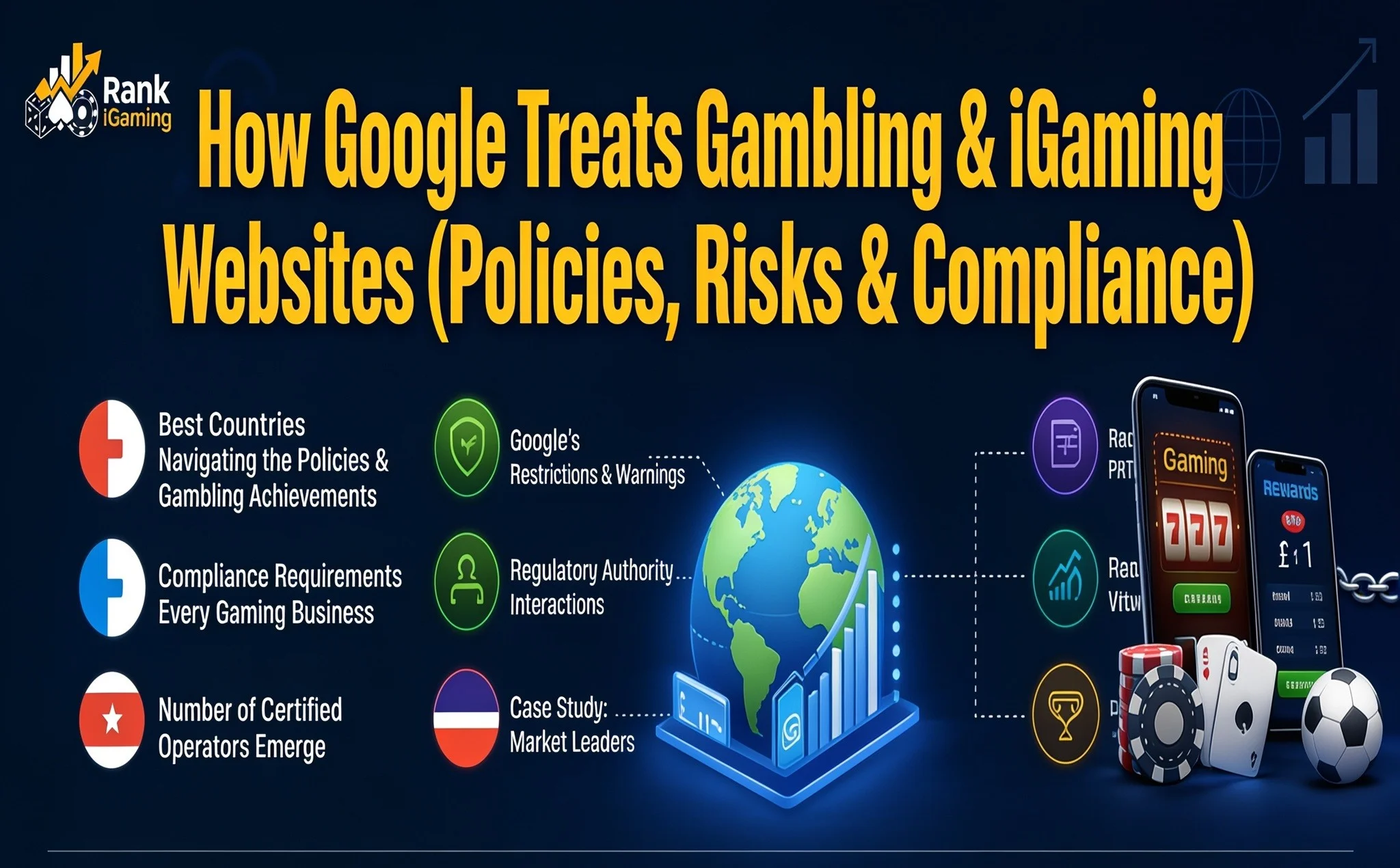
If you run a gambling website or work as a casino affiliate, Google is either your best friend or your biggest problem. There is no middle ground.
The truth is, Google watches gambling and iGaming websites more closely than almost any other type of website on the internet. One wrong move the wrong content, the wrong links, or the wrong author setup and your site can lose rankings overnight or disappear from search results completely.
This guide explains exactly how Google treats gambling sites, what the rules are, what the risks are, and what you must do to stay compliant. No complicated language. No vague advice. Just clear, practical information.
Google’s YMYL Classification: What It Means for Gambling
First, you need to know about YMYL. It stands for “Your Money or Your Life.”
Google uses this label for websites that can affect a person’s financial situation, health, safety, or general well being. If your content can hurt someone’s life in a serious way Google holds it to a much higher standard.
Gambling sites are classified as YMYL websites. Here’s why Google sees them this way:
- They involve real money transactions
- They can lead to financial loss
- They can affect mental health problem gambling and addiction are real concerns
Because of this YMYL gambling website classification, Google does not treat casino or betting sites the same way it treats, say, a food blog or a travel site. Instead, it applies its strictest quality checks to every page on your site.
What does that mean in practice? It means Google’s quality raters real humans who review websites are trained to look at your site and ask: “Can this site harm the person reading it?” If the answer is yes, or even maybe, your rankings suffer.
For operators and affiliates, understanding iGaming YMYL SEO is not optional. It is the foundation of everything. If you do not understand why you are classified as YMYL, you will never understand why your site is struggling to rank.
The E-E-A-T Framework Applied to iGaming
Once Google classifies your site as YMYL, it then evaluates it through a framework called E-E-A-T. This stands for Experience, Expertise, Authoritativeness, and Trustworthiness.
Google E-E-A-T gambling evaluation is how Google decides whether your site deserves to rank. Here is what each part means for iGaming sites specifically:
- Experience: Has the person writing the content actually used the product? For casino reviews this means real screenshots of gameplay actual withdrawal proof and genuine user accounts. A reviewer writing a detailed review without ever depositing at a casino raises a warning sign for Google.
- Expertise: Does the author know what they are talking about? In the iGaming space, this means listing author credentials clearly years in the industry, previous brands they have worked with, and qualifications in gambling regulation or responsible gaming. Sites like Casino.org set the industry benchmark here, with 15+ writers who each have 8–15 years of direct industry experience.
- Authoritativeness: Is your site or brand known as a voice that people can trust? This includes industry awards (EGR, SBC), backlinks from licensing bodies and regulators, and recognition in the Google Knowledge Graph or Wikipedia. If no trusted third party is talking about your site, Google has no reason to trust it either.
- Trustworthiness: This is the most important pillar for gambling sites. You need HTTPS across your entire site, a clearly visible and valid gambling license number on every page, transparent ownership information, accurate bonus terms and conditions, and correct RTP (Return to Player) data. Any inaccurate claim even one that is slightly misleading damages your trust score.
Trust signals for casino SEO are not just nice to have. For YMYL sites, they are ranking requirements.
The Google Helpful Content Update & iGaming
In 2024, Google made a major change to how it evaluates content quality. This update known as the Helpful Content overhaul hit approximately 20% of gambling affiliate sites with significant ranking drops.
Why? Because those sites were publishing content built for revenue, not for readers. Think: pages that are just lists of casino bonuses with no real analysis, generic reviews that copy information from the casino’s own website, or articles stuffed with keywords that don’t actually help the reader make a decision.
Google calls this “people-last content.” The iGaming Google helpful content upgrade was expressly meant to drive these pages down and reward sites that actually aid users.
Google’s Quality Rater Guidelines changed again in January 2025 false author personas are now regarded deliberately deceptive. If your site has author profiles that are made-up characters with stock photo headshots and fake credentials, Google’s quality raters are trained to flag such content as a trust violation.
Winners of these updates: sites with real expert authors, honest player-first guides, and content that answers genuine questions bettors actually have.
Losers: thin review mills producing 50 near-identical casino reviews per month with no real differentiation.
The message from Google is simple write for your reader, not for your commission.
What Google Explicitly Prohibits in iGaming
Understanding what Google bans is critical for gambling SEO compliance. There are two areas: organic search rules and paid advertising rules.
Organic Search Prohibitions:
- Targeting users in regions where online gambling is illegal. Even if your content is not directly advertising gambling ranking for gambling keywords in restricted markets can trigger manual actions
- Promoting unlicensed operators. If you are an affiliate linking to a casino without a valid license, you are sharing in their violation
Google Ads Gambling Certification: Running paid ads for gambling? Google Ads gambling certification is mandatory. Google requires operators to apply for market-specific certification before running any gambling advertisements. You may explicitly not target self excluded users or vulnerable persons. If you promise “guaranteed wins” or “risk free betting” you are in violation of Google’s rules instantly.
SpamBrain and Link Schemes: Google’s AI driven spam detection system SpamBrain was given a major boost in 2025. It now detects paid link schemes at casino scale. This is a direct hit on one of the most common iGaming SEO tactics: bulk buying casino backlinks. If SpamBrain flags your link profile, the only remedy is a full disavow file submission and active link removal outreach. There is no quick fix.
Does Google penalize gambling sites? Yes, directly and aggressively. And the penalties are severe enough to shut down a business that relies entirely on organic traffic.
6 Compliance Actions Every iGaming Site Must Take
This is the practical part. Whether you are an operator or an affiliate, these six actions are non-negotiable for gambling SEO compliance in 2026.
1. Publish a Responsible Gambling Page
This page must link to recognized organizations like BeGambleAware, GamCare and GamStop. It should explain how users can self exclude, set deposit limits and seek help. Without this page your site fails the basic YMYL trust test.
2. Display Your License Number on Every Page
Your valid gambling license number and the jurisdiction that issued it must appear on every single page of your site typically in the footer. It is not enough to have a license that only shows up on one page. Google looks at this to see how good it is.
3. Add Age Restriction Warnings
Put up clear 18+ or 21+ warnings all over your site for sites that are aimed at people in the US. These must be visible, not hidden in small print. This is both a legal requirement in most markets and a casino SEO trust signal that Google’s raters actively look for.
4. Use Real, Credentialed Authors with Verifiable Bios
Every piece of content needs a real author. That author needs a bio page that lists their name, their experience in the gambling industry, and ideally links to their social profiles or LinkedIn. Fake personas are now a direct ranking penalty risk.
5. Match Bonus Claims Exactly to Terms & Conditions
If your article says “100% up to £200 welcome bonus,” the terms and conditions linked from that page must match exactly. Any discrepancy even a small one is treated as misleading content under YMYL standards. Inaccurate bonus data is one of the most common reasons casino affiliate sites fail quality reviews.
6. Disclose All Affiliate Relationships Clearly
Make it clear on every page that has paid or commission-based links what your affiliate and partner relationships are. Use clear language This site contains affiliate links. We may earn a commission if you sign up through our links. Hiding commercial relationships violates both Google’s guidelines and, in many jurisdictions, consumer protection law.
Penalties: What Happens When You Violate Google’s Rules
There are two types of casino website Google penalties manual and algorithmic. Both are serious. Both are hard to recover from.
- Manual actions appear directly in your Google Search Console. Common manual penalties for iGaming sites include unnatural link schemes thin or low quality content, and cloaking showing different content to Google than to users. When you receive a manual action, your rankings drop immediately and visibly.
- Algorithmic penalties are invisible. You will not receive a notification. Your traffic simply drops after a core update. This is what happened to hundreds of gambling affiliates after the 2024 Helpful Content update. They never received a warning they just lost 40–70% of their organic traffic overnight.
- Google Ads account suspension for social casino or gambling violations in 2026 can happen without warning. If your ads violate the gambling certification requirements even accidentally your entire Google Ads account can be suspended.
- Recovery Timeline: After a manual action is resolved through a reconsideration request, recovery typically takes 6 to 18 months. That is not a typo. Algorithmic recoveries can take even longer because they depend on the timing of future core updates.
There is also a real-world risk: in regulated markets like the UK and Sweden, repeated Google policy violations can be reported to the gambling regulator, putting your actual operating license at risk.
FAQ — Google’s Treatment of Gambling Websites
Q: Does Google penalize gambling websites?
Yes. Google imposes manual actions that show up in Search Console and algorithmic penalties that quietly take down the rankings of gambling sites that breach its quality guidelines. The most common triggers are paid link schemes, thin content, fake author profiles and targeting restricted markets.
Q: Do I need a license to rank on Google?
Google does not directly require a license for organic rankings, but promoting unlicensed operators puts your site at serious risk. For Google Ads, a valid Google Ads gambling certification per market is required before any gambling ads can run.
Q: What is YMYL and does it affect my casino site?
Your Money or Your Life is what YMYL stands for. Gambling sites are subject to the highest Google quality criteria since gambling involves financial risk and the danger of injury. YMYL is short for Your Money or Your Life. Gaming sites are YMYL sites thus they have to comply with Google’s highest quality requirements because gaming entails a financial risk and potential harm. Your site is almost certainly classified as YMYL, which means every page is evaluated under stricter criteria than non-YMYL sites.
Q: How do I improve E-E-A-T for a gambling site?
To improve Google E-E-A-T gambling scores: hire real authors with verifiable gambling industry experience, publish their credentials and headshots, earn backlinks from licensed regulators and industry bodies, display your license on every page, add a responsible gambling section, and ensure all bonus and game data is accurate and up to date.