Anyone can put “540% traffic growth” on a homepage. Numbers like that mean nothing without context: growth from what, over what time period, and at what cost. We have created this iGaming SEO case study to tell you, step-by-step, in which context we would present it to a client.
Disclosure: This case study is a compilation of real campaign patterns that we observe in casino SEO work. For confidentiality, client data is anonymized and aggregated. The numbers are illustrative of a typical mid-size campaign, not a particular client’s private data.
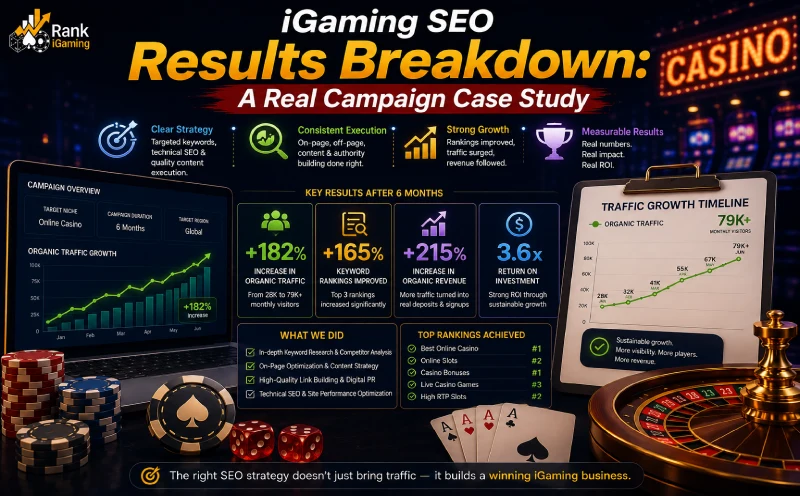
Those are the SEO results before and after summarized. The rest of this post breaks down exactly how we got there:
- Organic sessions went from 8,400/month to 53,800/month in 14 months (540% increase).
- Google’s top 10 keywords: 210 → 1,870
- Organic search first time deposits (FTDs) went from ~60 per month to ~410 per month
Now let’s break down where this site started, what was broken, and what we actually did.”
The Starting Point
The site was a mid size online casino operator licensed in one regulated European jurisdiction. It had been in operation about three years. Paid channels were decent in terms of brand recognition but organic search was almost dead weight.
What the site looked like when it came to us:
- Organic sessions: ~8,400 per month and trending down
- Rankings: almost nothing on the first page. Ranked brand name, plus about 210 mostly long tail keywords in top 10, most with tiny search volume
- Money keywords: its primary casino and slots keywords were between position 25 and 60
- Organic FTDs: Organic search produced about 60 first time deposits per month. All of this was transported by paid media
- History: account was with a previous agency for 18 months. Traffic grew for two quarters, then fell after a Google spam update and never recovered
This last point is important. It was not a new site with a clean slate. It was a niche with scars from previous SEO work, one of the most common starting points in this niche. This will be a pattern familiar to those of you that have ever seen your casino SEO results rise and then collapse after an update.
The Problems Found in the Audit
The first month was only an audit. No content. No links. No quick fix. In gambling SEO, doubling down on hidden problems just makes the eventual drop larger. Here’s what the audit actually found, in order of how much damage each problem was causing:
- Toxic backlink profile from the old agency. 40% of the referring domains to the site were of poor quality: expired-domain blogs with gambling posts in between unrelated content, sidebar links from sites in other languages, and exact match anchors like the main “casino” keyword in the market repeated hundreds of times. This is textbook private network work and it fell right in line with the drop in traffic after the spam update.
- Google couldn’t see the game lobby. The casino used JavaScript on the client side to run its lobby and game pages. Google’s crawler saw a nearly empty page, while players saw hundreds of games. The actual games, the biggest content asset on the site, were contributing almost nothing to rankings.
- Roughly 1,400 thin, auto-generated game pages. When the game pages were indexed, they all used the same template, 40 words long, with only the name of the game changing. To Google it looked like 1400 copies of the same low-value page. That much thin content will tank the quality score of the whole domain, not just those pages, in a YMYL niche.
- Duplicate Bonus and Promotion Pages. The old promo pages never did go down. There were a dozen bonus pages that were almost identical and duking it out, so Google kept changing which one it would rank, and none of them were sticking.
- Weak trust signals for a gambling site. No author info on guides, no licensing info on content pages you can see, and responsible gambling info hidden away in the footer of one page. These signals are part of Google’s process of determining whether a site deserves to rank at all for a YMYL category like gambling.
- Internal links pointed the wrong direction. The blog contained many internal links to other blog posts, while the money pages (game categories, payment guides, sign-up path) had almost none. The site authority was flowing to pages that would never be able to make a deposit.
Note that none of these issues come up in a generic “we’ll boost your rankings” pitch. They only appear when someone actually goes to investigate the site. So we always start with the audit, and it’s the same process we run inside our casino SEO services for each new project.
The Strategy Applied, Phase by Phase
We had four phases of 14 months of work planned. What each phase entailed and why it came in that order is described below.
Phase 1 (Months 1-2): Stop the bleeding
- Full audit (as above) and prioritised list of fixes
- toxic link profile disavowed and documented everything just in case there’s ever a manual review
- Finally added the server-side rendering fix to the game lobby so Google could see the games
- Merged the 12 duplicate bonus pages into one strong page with proper redirects
- Temporarily set 1,400 thin game pages to noindex to stop them dragging quality down whilst we planned the rebuild
No new content at this time. No new links. Phase 1 was about getting rid of the negatives because in this niche removing damage often moves the rankings before you add anything new.
Phase 2 (Months 3-5): Rebuild the content foundation
- Rewrote the 120+ game pages with original content, how the game works, volatility and RTP explained in simple terms (no odds claims, no winning promises) and real screenshots.
- Built out payment method guides for the market as “casino + payment method” keywords had great intent and less competition than the head terms
- More author bylines with real expertise signals, visible license info, and a proper responsible gambling section linked from every content page
- Reorganised internal links to give category pages and payment guides the most links instead of old blog posts
Phase 3 (Months 6-9): Earn authority
- Began white-hat link building with data-led content that gambling and mainstream publishers actually wanted to reference, plus outreach to the site’s market
- Average 8-12 quality referring domains per month. That sounds small in gambling, until you compare it to what quality costs in this niche; volume was never the goal
- Content production is in progress at 6-8 pieces per month based on the keyword gap analysis against top 3 competitors in the market
Phase 4 (Months 10-14): Expand and defend
- Once the core rankings were stable, expanded into live casino and game provider keyword clusters
- Refreshed pages that landed positions 4-10 because that’s where small improvements give the biggest traffic jumps
- Daily rank tracking and weekly technical monitoring are a must. Casino SERPs are volatile and negative SEO attempts are common in this niche.
If you find this timeline slow, that’s the honest truth of the vertical. We wrote a full explanation of why in our guide on how long iGaming SEO takes and the short answer is the first months are cleanup and compounding growth comes after.
The Results
Here are the full SEO results before and after pictures, measured at month 0 and month 14:
| Metric | Before (Month 0) | After (Month 14) | Change |
| Organic sessions / month | 8,400 | 53,800 | 5.4 |
| Keywords in top 10 | 210 | 1,870 | 7.9 |
| Keywords in top 3 | 14 | 240 | #ERROR! |
| Organic FTDs / month | ~60 | ~410 | 5.83 |
| Quality indexed pages | ~600 | ~1,450 | 1.42 |
| Referring domains (quality) | 310 (40% toxic) | 720 (cleaned) | #ERROR! |
Some honest notes on these casino SEO results, because numbers without context is what this post is all about:
- Growth wasn’t a straight line. The first 4 months were flat almost. The first obvious jump was at month 5, after the rendering fix and the rewritten game pages were fully indexed. The fastest growth was between month 8 and 12.
- The traffic number isn’t as important as the FTD number. Ranking for junk keywords can inflate sessions. What the business actually feels is first time deposits from organic search and that’s the metric we report on first.”
- There was one Google core update in the campaign (around month 9). The whole point of building on clean foundations is that the site becomes more visible, not less so, during that process. That’s the practical difference between white hat and shortcut work. We compare the two approaches head to head in our white hat vs black hat iGaming SEO breakdown.
What We’d Do Differently / Lessons Learned
No campaign is perfect, and case studies become less credible when they pretend otherwise. Here’s what we’d do differently if we were to do this exact project again:
We waited too long on the meager game pages. We set them to noindex in month 1 but didn’t start rewriting until month 3. In hindsight, if the rewrite had been started in parallel with the technical work, the first growth jump would have been about a month earlier.
We underestimated the time it takes to get content through compliance review. Each guide had to be legally reviewed by the operator before it went live, adding one to two weeks to each batch that we hadn’t accounted for in the original content calendar. “We now bake in legal review time on every casino content plan from Day 1.
Digital PR should have been started earlier. Serious outreach began in month 6 when the content foundation was ready. The logic was solid, but the best links took two to three months from initial contact to go live. If I had started building relationships in month 3, even before pitching, it would have compressed the authority phase.
We blogged up a storm for a while. In months 4-5 we published a few informational posts which a year later are driving traffic but virtually no deposits. Part of that budget could have bought more FTDs had it gone into one more payment-guide cluster. Traffic that never converts is a vanity metric and we cut that faster now.
But none of these errors sunk the campaign. But a case study that assumes zero friction is marketing, not evidence, and this post is supposed to be evidence.
Takeaways for Readers Running Their Own Site
Regardless of whether you ever hire someone, you can apply the pattern from this iGaming SEO case study to your own project:
- Audit before you build. If your site has any SEO history at all, assume there is hidden damage. Toxic links, thin templated pages or rendering issues. It is generally better to fix negatives than add positives, especially in the first quarter of work.
- Look at what Google is actually seeing. If your games, odds or lobby are loaded via JavaScript, then check how the rendered page looks to a crawler. This one technical problem silently caps more casino & sportsbook sites than any content problem.
- Judge deposits, not sessions. Ask any agency showing you casino SEO results one question, how much of that traffic converted? Anything that can’t relate rankings to FTDs or at least signups is decoration.
- Prepare for the flat months. The first 1-4 months of this campaign seemed like nothing was happening. If you pull the plug or change strategy in that window, you pay for the cleanup twice and never get the growth.
- The pattern is the same, but the details aren’t. A case study of SEO for a sportsbook would have the same phases, but different problems: structured data for events, crawl management for thousands of match pages that expire, and content that has to update in near real time. Different battlefield, same discipline. (If that’s your vertical, check out our sports betting SEO page for more on how the approach differs.)
- Trust signals in gambling ranking work. In this niche, there is no legal decoration, especially not author expertise, visible licensing and clear responsible gambling information. Google looks at them as part of whether a YMYL site deserves to be visible. Build them in from the start and mean them. Responsible gambling messaging protects your players, and not just your rankings.
If you want to see the pricing side of a campaign like this, our iGaming SEO pricing guide breaks down the costs of each stage at different scopes.
FAQ
Q: Is this iGaming SEO case study based on a real client?
A: It’s a composite of real campaign patterns from our casino SEO work, with the details anonymized and aggregated for confidentiality. These numbers are in line with a mid-sized campaign. The reason we use a composite is so we can show the entire process, mistakes included, without exposing any one client’s private data.
Q: How long did it take to see the first real results?
A: The first clear jump was in month 5, once the technical fixes and rewritten pages were fully indexed. Between months 8 and 14, we grew first-time deposits, which are meaningful business impacts. That is an average timeline for competitive casino markets.
Q: What mattered most: content, links, or technical fixes?
A: The order was the most important thing. First technical cleanup and link disavowal. Content is second, links are third. Doing the same work in a different order would have produced weaker results, because new content and links built on a damaged foundation inherit its problems.
Q: Would the same approach work for a sportsbook?
A: The phases would be the same, but the problems would be different. Sportsbooks are dealing with live data feeds, expiring event pages, and large structured data requirements. The audit-first, deposits-focused discipline carries over entirely; the technical checklist does not.
Q: Can I expect the same numbers for my site?
A: No, and watch out for anyone who says yes. Results depend on your market, competition, site history and budget. The shape you get from a well-run campaign is the same: flat cleanup months and then compounding growth, measured in real business metrics, not vanity traffic.
Want to Know What Your Version of Month 1 Looks Like?
Each of the campaigns in this post began with a full audit to identify the actual problems before anyone touched content or links.
You will get the same audit for your casino or sportsbook site: technical, content, backlinks, and trust signals, with a prioritized roadmap you keep regardless.
Get a similar audit for your site →
RankiGaming works with licensed operators and affiliates. We believe in gambling responsibly. If you or someone you know has a gambling problem, help is available through your local support organizations.