
Well, first the disclaimer. Because of course this subject requires it: This article is not legal advice but general tips for marketers and site owners. “Gambling rules in the UK are always changing and the devil is in the detail. Always check the current legislation with a licensed compliance professional or with the UK Gambling Commission directly before you rely on anything here.
That said, if you run or promote a casino or betting site that targets the UK, your content is controlled. Not your advertisements. All your landing pages, supplementary pages, reviews and blog entries are in line with the UK advertising rules. Getting your UKGC compliance content right protects your license and (as we’ll show you) it’ll help your rankings, too. What must be on the website, what can never be, and how to check out your own site.
What the UKGC Actually Regulates
Quick correction, because this throws a lot of marketers off: The UKGC, the licensing regulator for Great Britain. It sets out the License Conditions and Codes of Practice (LCCP) which all licensees must adhere to and those conditions filter down to your marketing.
But content rules don’t come from one source.
- The UKGC/LCCP sets out what licensed operators must do, including how they communicate conditions, protect players and market responsibly.
- The ASA and the CAP Code provide down the standards for any gambling advertising or promotion, wherever it appears, in the UK. This is regulated by the Advertising Standards Authority. It also applies to affiliates, not just operators.
- There are also industry codes (e.g. the IGRG socially responsible advertising code) that significant operators commit to.
The practical upshot: Some combination of these UKGC content restrictions applies to you in publishing content that encourages gambling to a UK audience. Saying “we are just an affiliate site” is not a get out of jail free card, affiliates are in the same perimeter as the operators they promote and enforcement in 2025-2026 has made it very evident.
Required Content Elements on UK-Facing Gambling Pages
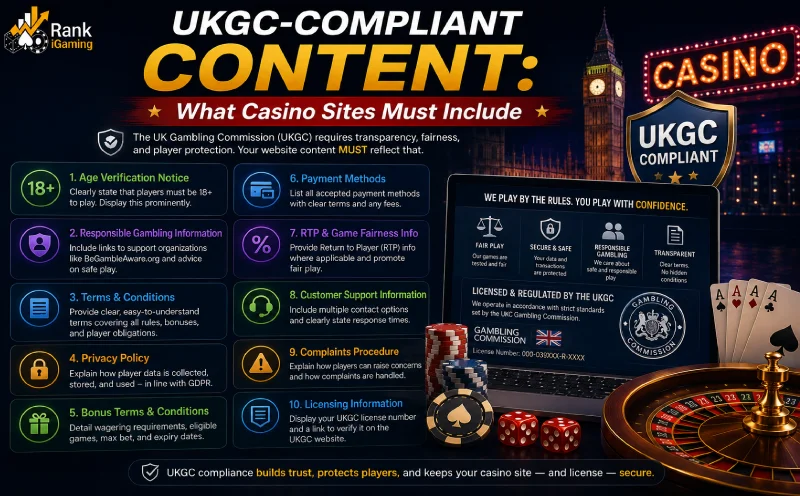
This is the kind of thing you’d expect to see on UK gaming pages. They are like the furnishings of every page, the non-negotiable elements:
- Age Verification (18+) Where you are including gambling content you must make it clear that it is for adults only. If you are promoting something you need to designate it as “18+.” Your site must not promote any activity that under-18s can participate in. Operators also need to undertake actual age verification upon sign up, and your content should reflect that reality, rather than glossing over it.
- Links and resources for responsible gambling on the UK-facing website should direct gamers to support services for safer gaming. In practice this means clear links to gambling support services and to GAMSTOP (the national online self-exclusion scheme that licensed UK operators must participate in) and references to the player protection measures operators make available: deposit limits, time-outs and self-exclusion. This is the heart of responsible gambling copy guidelines the help should be searchable not buried.
- The terms of the offer are significant. Enforcement is strongest here in the UK and rules were strengthened again in January 2026. Material terms of a bonus (wagering criteria, expiry, game limitations and caps for example) must be directly displayed with the offer before the player agrees, not hidden behind a link three clicks away. New constraints also exist in the UK on how incentives can generally be structured (including capping wagering requirements) so bonus wording needs to match what is actually permissible and not what was common five years ago.
- License disclosure. Licensed operators should state that they are licensed and regulated by the Gambling Commission and, if appropriate, give the license number and a link to the operator’s entry on the Commission’s public register. For affiliates, this means correctly describing an operator’s licensing status (and never promoting unregistered operators to UK players).
- Absolutely honest and not deceptive. All information on the page must be factually accurate and verifiable. That includes bonus amounts, “free” claims, payout speed, and any stat you name. Advertising for casinos in the UK that is “technically truthful but misleading” is still banned.
What’s Prohibited
The list of forbidden objects is as important as the list of needed goods. Gambling content directed at the UK must not:
Very appealing to those under 18. This is bigger than “don’t target kids.” Gambling promotions may not feature information, photos or selections of celebrities or sports stars that strongly appeal to children. Hence the withdrawal of top-tier footballers and youth-focused celebrities from UK gambling ads. For content teams, it means no cartoon-styled creative, no framing with young slang, and careful evaluation of every individual you reference.
Lie about incentives. These are all standard enforcement triggers: Fronting with a headline figure the small text robs or calls something “free” with wagering terms or hides a max-cashout cap. UK regulators have penalized operators big time for exactly this pattern.
Build on the victory. Gambling shall not be presented as a way of obtaining money, addressing financial problems or attaining prestige. * Win-centric framing (“turn £10 into £500!”) is out. So it is saying that skill will always triumph in games of luck. This is in line with our own practice across the site, we never ever write any win guarantees in any market.
Pressure or Exploit. Urgency tactics (“last chance!” and countdown pressure on sign-up incentives) and content targeting vulnerable populations or portraying gambling as an escape from difficulties violate the standards.
Market minus government. Direct marketing to clients in the UK will require a granular opt-in for each product and each channel from May 2025. This is more of an operator-side CRM rule than an on-page rule, although content teams should be aware of it when drafting email and SMS text.
How Compliance Content Intersects With SEO
Here’s the thing most compliance guides don’t include and the reason an SEO agency is writing this at all: compliant content and ranking content are one in the same in this industry.
Gaming is a YMYL (“Your Money or Your Life”) category, and Google pays special attention to experience, expertise, authoritativeness and trust (E-E-A-T) while viewing gaming pages. Now look at what the UK standards expect of you: identify who is licensed, be clear about your terms, provide links to legitimate assistance resources and do not make misleading representations. These are also trust signals that Google’s quality systems are designed to reward.
Auditors see this all the time. Sites that provide transparent licensing information, honest bonus presentations and accessible safer gambling resources are likely to hold on to ranks via core revisions. Sites that are full of hype and hide their terms go down. Our tutorial explains how Google treats iGaming websites, but the basic explanation is that UKGC compliant material doesn’t weigh down your SEO. Your SEO.
This is also why compliance aware writing is incorporated into our gaming SEO services, not added on later. It is cheaper to do it right the first time than to retrofit compliance into published material.
A Simple Compliance Checklist for Site Owners
Compare this list to every facing page of the UK. This is not a comprehensive list (your compliance professional will have more on their list than this) but it does cover the most common gaps:
- 18+ Messaging appears on page and in promo blocks
- Gaming links are safe and working (help services + GAMSTOP for UK audiences)
- Where mention is made to player protection tools (deposit limits, time-outs, self exclusion)
- Important bonus terms (wagering, expiry, game restrictions, caps) are related to the offer and not disguised behind extra clicks
- Correctly reported license status, license number and link to register if applicable
- No content or visuals likely to have a good appeal to under 18s
- No frame on the page of a winning-money solution
- All facts (bonus amounts, payout speed, data) are current and can be verified.
- CTAs and promotional content cannot use pressure or urgency tactics.
- There is an outdated review process. Rules in the UK altered in 2025 and again in 2026. Old pages don’t update themselves.
Print it, share it with your writers and make it part of every content brief, as we do inside our casino SEO services.
Common Mistakes That Trigger Reviews or Penalties
The most common trends we detect in audits of UK-facing sites are, in rough order of frequency:
Old bonus pages that no one had maintained. The offer has changed and the restrictions have changed (especially with the January 2026 incentive conditions) however the 2022 page still ranks and still shows the old terms. Old promotional postings are a compliance issue and trust issue with Google.
Terms purposefully hidden. The material terms are in grey 9px lettering below the fold or in a collapsed accordion. Regulators decide what an average reader actually sees.” If the headline offer is screamed, but the wagering condition is mumbled, the page fails.
In the UK copy for other markets was reused. Teams who look after more than one market convert aggressive win-framing that may be appropriate elsewhere to UK pages. UK compatible pass on all UK pages. Translation ≠ Localization. Find and replace is NOT a localization.
Affiliates who believe they’re above the rules. Affiliate reviews and bonus listings are UK marketing under the laws. Affiliates utilizing fraudulent conditions or advertising unauthorized sites in the UK are putting themselves and any operator they work with at risk.”
Gambling duty as a decoration. Footer symbol, no link works Not reviewed for one year on the support page. Plans altered. Safer gaming content needs to be real and relevant for players and regulators alike. More than rankings, we care about it. This is a company only sustainable if player protection is real.
If you have any of these problems, fix them before scaling anything else. Gaining new rankings on pages that put your license or your operator partnerships at risk is not very useful. And if you’re reviewing outside help, our checklist on how to choose an iGaming SEO agency describes how to determine whether an agency actually knows compliance or just pretends it.
FAQ
Q: Do UKGC content rules apply to affiliate sites or only licensed operators?
A: UK advertising restrictions (the CAP Code, enforced by the ASA) apply to affiliate content that promotes gambling to UK audiences, and operators are also held accountable for the marketing done by their affiliates. In practice, affiliates are expected to uphold the same content standards as the operators they promote.
Q: What are the responsible gambling copy requirements for a UK casino page?
A: Minimum: Clear 18+ messaging, working links to gambling support services & GAMSTOP, references to player-protection mechanisms like deposit restrictions and self-exclusion, and no framing of gambling as a money-making solution. It’s not just about existence, it’s about placement. The content has to be actually findable.
Q: Can compliant content still rank well against aggressive competitors?
A: Yeah, and it usually ranks higher in the long run. Gambling is a YMYL category, and Google’s quality measures reward the same trust signals the UK rules require: license openness, honest terms, and real player-protection resources. Hype pages tend to surge and then drop through core upgrades.
Q: What changed in the 2026 UK rules that content teams need to know?
A: The greatest changes to consumer-facing rules are tighter rules on how bonuses and incentives are structured and presented (including caps on wagering requirements and better presentation of material conditions) following the granular marketing-consent rules that came into force in May 2025. Any bonus page written before these modifications needs to be reviewed.
Q: Is following this article enough to make my site compliant?
A: Nope. This is to provide marketers with a general understanding of the landscape. Actual compliance is dependent on your license type, your role (operator or affiliate) and rules that are ever changing. Check your exact duties with a qualified compliance specialist or the Gambling Commission itself.
Need Content That Ranks AND Passes Compliance Review?
Most content teams can write for Google. Or write for the regulator. You need both in the same document in this niche.
Every UK-facing content brief we provide includes compliance checks – license accuracy, terms presentation, safer-gambling features and the E-E-A-T signals that hold rankings through revisions.
Let’s discuss compliance-aware content →