
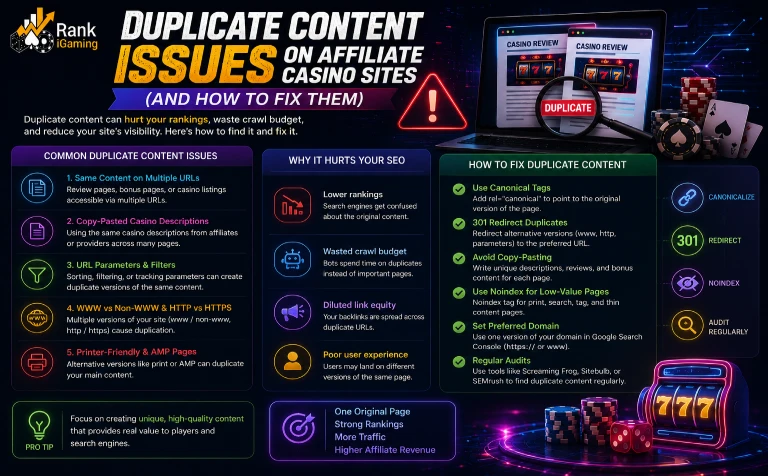
Duplicate content is the silent killer of casino affiliate sites. It is not known for a big overnight crash. Instead, pages just gradually stop ranking and fresh content takes longer to index and then one day you see Google choose a different page than the one you wanted to rank or no page at all.
The aggravating thing is that most of the duplicate content casino affiliate problems are self-inflicted with them being incorporated into the site’s own templates and workflows. Which is actually good news, because it implies you can fix them yourself. In this article, we’ll explain where the duplication is coming from, how you may detect it on your own site and which fix is appropriate for a specific scenario.
First: A definition to get correct. Google does not issue a formal “duplicate content penalty” for plain old duplication. It’s quieter than that, and just as damaging. Google filters comparable pages against each other, separates your ranking signals amongst copies, spends your crawl budget and decreases its overall quality assessment of the domain. And as of 2024, publishing scaled, low-value pages at volume is explicitly treated as spam under Google’s scaled content abuse policy. For a YMYL niche like gambling, where the standard is already set high, sites get very little benefit of the doubt.
Why Affiliate Casino Sites Are Especially Prone to This
It’s the affiliate business model itself that produces this duplication. Consider what a typical casino affiliate site publishes:
Hundreds of near-identical review pages.
Fifty casino reviews were built from one template: the same section order, the same intro pattern, and the same pros/cons phrasing, with only the brand name, bonus figure and logo swapped. To a reader they are separate pages. They are one page to Google’s systems, fifty times over.
Game and slot pages at scale.
A slots section can contain thousands of pages, and most are produced from supplier data: the same 60-word description format, the same stats table, and different game titles. Here the problem of duplication and the problem of thin content gambling sites are two sides of the same coin. The pages are too similar and too empty.
Bonus pages that clone each other.
“Best welcome bonuses,” “best no deposit bonuses,” and “best free spins offers” – three URLs with much the same operators listed, much the same descriptions, fighting for overlapping keywords.
Geo pages with a find-and-replace localization.
Best Casinos in New Zealand Best Casinos in Canada 90% Similar, Only the Country Name Changed. We discussed the importance of actual localization on a market-by-market basis in our US state-by-state casino SEO guide and the same applies to all geo templates.
Syndicated operator descriptions.
Many affiliates simply copy the terms of the bonus and casino descriptions straight from the operator’s own press kit. The same press kit that every competing affiliate received. Now you are duplicating across the whole niche not just on your own site.
None of this is any fault of these affiliate teams being lazy. Templates are how you publish at scale. That’s why it happens. The cure is not to throw templates out but to identify where the template finishes and the unique material has to begin.
How to Spot Duplicate Content on Your Own Site
Run this check before you go poking around. 30 minutes, 3 steps:
1. Open Search Console’s page indexing report.
Be on the lookout for these statuses: Duplicate without user-selected canonical, duplicate, Google chose a different canonical than the user, crawled, currently not indexed.” Here large numbers mean that Google is openly informing you it sees duplicates. Open each status and see what templates are common to the URLs affected The pattern is nearly always one or two page types.
2. Run a site-wide similarity scan.
Crawl based similarity tools (Siteliner style scanners or the duplicate detection in most SEO crawlers) tell you what percentage of the text of each page is shared with other pages on your site. As a rule of thumb, any duplicate text of similarity exceeding 60-70% on casino affiliate template content is a red flag to investigate. Sort by similarity and you will usually get one template doing most of the problem.
3. Spot-check against the rest of the niche.
Search on it in quotations. Find a sentence in your review boilerplate. If ten competing sites have the exact same sentence, you have uncovered syndicated press-kit text. Plagiarism style checkers accomplish the same thing — just at scale.
While you are about it, check to see if your indexed page count is much higher or lower than the pages you wish to rank. A site with 800 genuine pages and 12,000 indexed URLs has a duplication problem lying in parameters, tags, or pagination someplace.
Canonical Tags: What They Fix (and What They Don’t)
Canonical tags are the most misunderstood technique in this whole domain, so let’s define the boundaries clearly.
What a canonical tag is: a piece of code that tells Google, “Of these similar URLs, this one is the main version; give it the signals.” It consolidates. It does not hide, delete or improve anything.
What canonical tags fix on a casino site:
- URL versions of the same page: tracking parameters from affiliate programs (?ref=,?btag=), session IDs, filter/sort parameters on game lobbies
- www vs non www http vs https trailing slash duplicates
- Printer-friendly or AMP-style alternatives
- Valid near-dupes where one version is expected to win, e.g., a bonus page existing at two paths
What canonical tags do NOT fix:
- Fifty slender pages of reviews, all meant to be read alone. Consolidating them to one page means forty-nine of them stop ranking on purpose; that’s consolidation, not a fix
- Quality of content. Canonical tags casino site cleansing ensures signals flow to the proper URLs, but if the chosen page is thin, it ranks like a thin page with tidy plumbing
- Cross domain operator press kit replication: your canonical does not determine what fifty other affiliates publish
And one caution we see time and time again in audits: canonicals are suggestions, not orders. If your “duplicate” sites have different internal links, sitemap entries and titles, Google may reject your canonical and choose its own, which is exactly the “Google chose different canonical” status from the Search Console check above. Ensure all signals are consistent: canonicals, internal links, and sitemaps should all point to the same preferred URL.
Differentiating Templated Pages With Real Unique Content
Here’s the real cure to templated duplication: Let each page justify its right to exist. The current page is 1. The current page is 1. The current page is “Some approaches that work with gambling sites:
Write unique openings from real experience.
Skip the generic intro (“Brand X is a popular online casino with many games…”) and lead with the one thing that really makes that operator stand out: the withdrawal that got processed in four hours, the unusually good game filter, or the support chat that sat for two days. One good specific paragraph is better than three general ones.
Inject per-brand and per-game data points.
Verified license number and regulator Withdrawal time tested Actual games count on the day of review Minimum deposit carried by suppliers. Different data page by page automatically is just what a differentiated page needs. Here’s the approach that turned around the thin game pages in our iGaming SEO case study: 1,400 templated pages became rankable by rewriting the top slice with genuinely unique substance.
Give every page its own FAQ.
Do not repeat the same 5 questions in each review. Ask what a player would actually ask about this brand or game: “How long do withdrawals take at [brand]?” or “Does [slot] have a bonus buy feature?” Unique FAQs give you unique text, unique long tail questions and feed your FAQ schema truthfully.
Vary the editorial verdict.
If all your reviews say “overall, a solid choice for players,” then you wrote 0 reviews. Real opinions differ, promote other types of players or even say “skip this one.” Here differentiation and credibility are one and the same work.
Set a uniqueness budget per template.
One practical criterion we use: at least 40-50% of the text that is visible on every templated page needs to be impossible to paste into a sibling page without being erroneous. If a paragraph works on every page it is part of the design of the template not part of its searchable content.
Prioritize by revenue: separate out the 20 pages that generate deposits first, then work down. Nobody rewrites 2,000 pages at once, and nobody needs to.
When to Consolidate Pages Instead of Fixing Them
Do not store duplicate pages. If the page is targeting an actual, separate query, then a rewrite is the proper call. Otherwise consolidation is the way to go. Merge or delete when:
Two pages chase the same keyword.
If you have “best free spins bonuses” and “top free spins offers” then they will cannibalize each other for life. Merge into one stronger page, 301-redirect the loser, and update internal links
A page has no search demand of its own.
Thousands of no-search-a-month micro variation slot pages don’t need distinct material, they need to be merged into provider or category pages or otherwise noindexed if they exist only for users.
Old promo pages have expired.
Dead bonus pages from years ago should redirect to the current equivalent, not exist as thin duplicates. (Stale promo content is also a compliance problem in regulated marketplaces, so this cleanup pays off twice.)
The math doesn’t work.
Real differentiation takes writing time. If a page can’t realistically recoup that investment in traffic or conversions, combining it into a stronger page is the honest business option.
The strategic reason behind all of this: Google’s quality systems evaluate casino sites at the domain level, so every thin duplication pushes down every decent page you possess. In our dissection of how Google treats iGaming websites, we explain the site-wide quality algorithm and why cleanup often boosts ranks on pages you never touched. In this area less is more. More powerful pages always beat less powerful pages. As with our technical work in iGaming SEO services, we strip the weight before we build the muscle.
FAQ
Q: Does Google penalize duplicate content on casino affiliate sites?
A: Not usually with a formal penalty. Google takes the best version and throws away the remainder and separates your signals to ordinary duplicates. The only exception is publishing a lot of low-value templated pages, which may be considered spam under Google’s scaled content abuse policy. Gambling sites are watched closely. Whichever way, the price is paid in traffic.
Q: How much can review pages share the same template before it’s a problem?
Problem: OK structure, shared text. A good rule of thumb is to have at least 40-50% of the visible text on each page unique to that page: real data points, real testing notes, page-specific FAQs and an honest verdict. If you could switch the wording of two reviews and nobody could tell the difference, they would be duplicates.
Q: Will canonical tags fix my thin content gambling site problem?
A: No, canonicals aggregate signals across duplicate URLs, they do not add quality. Use them for parameter and URL-variant duplication, rewriting for pages that should rank on their own, and consolidation (merge + redirect) for pages that never should have been separate.
Q: Should I delete or noindex my thin slot pages?
A: It depends upon the demand. Make a page actual players hunt for with unique substance If there is no demand for search but it helps users to browse, noindex it. If it does neither, then redirect it to the appropriate category or provider page. Delete without redirect loses links and signals page acquired.
Q: How long does recovery take after fixing duplicate content?
A: Not days, weeks to a few months. Google has to re-crawl those cleaned templates, reprocess canonicals, and re-evaluate the quality picture of the domain. The larger end is affiliate sites with thousands of affected URLs. Couple the cleanup with an updated sitemap to speed recrawling.
Get an Audit That Checks for This
Audit for this duplication lurking in templates, parameters, and page types you stopped looking at years ago, silently capping every ranking your good content earns.
Our audits show precisely which templates are generating duplicate and thin pages on your site, how to fix each (canonical, rewrite, or consolidation), and in what order to get the fastest recovery.
Get your duplicate content audit here →