
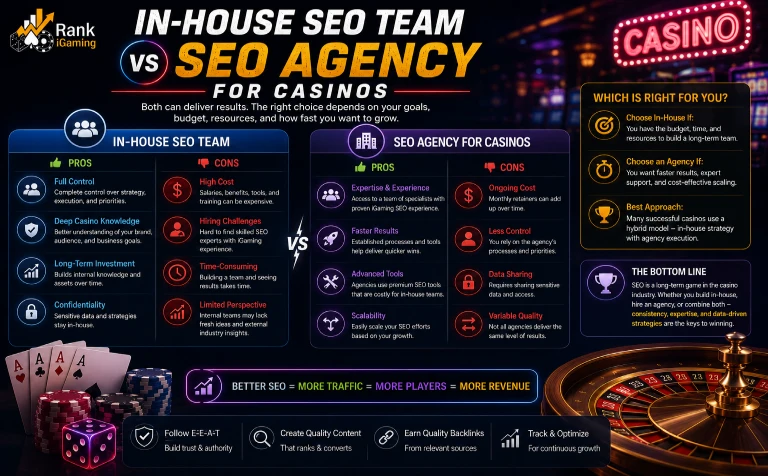
This is a question every operator finds themselves asking: create an SEO staff or hire a specialist agency? There is no one size fits all answer but there is a right answer for your unique size, budget and timeframe. This spells out what each alternative costs, what each option takes, and where each option wins.
We do both sides of this conundrum all the time. We do strategy for operators that have in-house teams and we run comprehensive SEO for operators that don’t. So this is not a theory . This is what we are seeing from real world casino SEO spend.
What “In-House” Actually Requires
The most typical miscalculation in this sector is to “hire an SEO person. ” Casino SEO is not one talent, it’s four. Gambling adds a fifth one that most niches will never need.
Technical SEO.
Someone who knows crawlability, indexation, site performance and structured data and can actually collaborate with your dev team (or be your dev team) to implement fixes. They don’t rank themselves. They get the blockers out that are holding everything else up.
Content strategy and copywriting.
Casino material needs to appease players, meet Google’s YMYL quality level, and adhere to advertising guidelines, all in the same paragraph. That’s rarely one person’s work at real volume; most in-house setups need a strategist plus one or more writers who know the area, not generalists learning it on your dime.
Link building.
The slowest and most specialized skill to build in-house. Good gaming linkages require partnerships with publishers who will really embrace a casino brand, which takes years to create and cannot be hastened by recruiting alone.
Compliance review.
The role conventional SEO advice never mentions Every piece of material in a regulated market has to be reviewed against license laws, ad standards, and responsible gambling criteria before it publishes. Skip this role and you’re one published page away from a regulator encounter.
Add them together and should I employ an in house seo team casino ceases being a single hiring and becomes a small department: a strategist or lead, one to two writers, a technical resource (in-house or shared with dev), and a compliance reviewer, plus tools, training, and management overhead. Most operators don’t recognize this until they’ve employed their first staff and see the holes.
What an Agency Provides Instead
One contract, one agency, all of the department. It’s not just the numbers that make the practical difference, it’s what a specialist team knows on day one.
No hire timing, all 4 skills included.
You already have a strategist, authors, technical specialists, and a compliance-aware review process who know casino material, so you avoid the months of a new hire learning the niche on your account.
Pattern recognition over a lot of gambling clients.
An agency that operates across casino and sportsbook accounts has already seen what a Google upgrade does to gambling SERPs, which sources get penalized, and which content structures escape scrutiny. You don’t get that with your first in-house employment. It takes many client cycles to build and an agency has already been through them.
Flexibility to scale.
Adding a second market or boosting content output, that’s an agency scope conversation. It’s a recruiting procedure within your organization, it’s a training term and a new fixed expense, whether or not that capacity is totally used each month.
No one point of failure.
And you lose the institutional knowledge of your account when you lose an SEO recruit. An agency disseminates such information across a team, so your campaign doesn’t halt if someone leaves.
The honest tradeoff: you receive less direct, day-to-day control than managing your own employee, and you’re relying on someone else’s ambitions alongside yours. That is a genuine expense and a cost we should certainly name, not brush over.
Cost Comparison
This is what you usually pay to travel on the line. These are planning ranges not bids and exact numbers depend on market and scope.
| Cost Factor | In-House | Agency |
| Monthly cost (typical mid-size operator) | $15,000-$30,000+ (fully loaded: salaries, tools, overhead) | $3,000-$15,000 (scope-dependent) |
| Upfront cost before results | Recruiting, onboarding, tool licenses: often $10,000-$20,000 before any content ships | Minimal; work usually starts within the first billing cycle |
| Tool stack | Separate SEO, content, and rank-tracking subscriptions ($500-$2,000+/month) | Usually included in the retainer |
| Skill coverage per dollar | One person covers one or two of the four skill areas well | The full team covers all four as standard |
| Cost of a bad hire | Salary and severance sunk, plus months of lost progress | Cancel or renegotiate the contract; sunk cost is far lower |
| Scaling cost | Linear: each new skill or market usually means a new hire | Often just a scope adjustment within the existing relationship |
The trend in that table: in-house is more expensive per month for less skill coverage, but every dollar is staying inside your organization and building an asset you own long-term. An agency is less expensive to get started and to scale but the knowledge walks out the door when the contract finishes. It is also not necessarily the smartest spend, it relies on your time horizon, which the parts below help you decide. If you want to see everything that affects agency pricing, then check out our guide to iGaming SEO pricing.
Speed to Results Comparison
Casino SEO agency vs in house isn’t simply a cost question, it’s a timeline question, and the two approaches move at very distinct paces.
- In-house speed to first results: Add in recruiting (4-8 weeks for a specialized hire in this niche), onboarding and ramp-up (4-6 weeks to learn your site, market, and compliance requirements), and then the actual SEO timeline on top. Realistically, 5-7 months before an in-house hire is delivering important unblocked work, more if you’re developing more than one role.
- Agency speed to first results: The skill set is already there, therefore onboarding takes weeks not months. Usually audit and strategy fall in the first 30 days, and first technical fixes and content ship soon after. With either approach, the SEO schedule is the same (gambling rankings take months no matter who performs the job), but the agency route removes the recruiting delay altogether.
This is the single strongest speed justification for agencies: not that they work faster once running, but that they eliminate the 2-3 months most operators lose before an in-house recruit even starts producing.
Risk Comparison
Casino SEO has hazards that other niches don’t have and the way in which each model addresses them is very different.
Compliance mistakes. A lone or small in-house team without a dedicated compliance reviewer can publish non-compliant bonus wording or miss a mandatory responsible gambling declaration because no one’s special duty was to notice it. A specialist agency has compliance review built into every content pass by default since it’s seen the consequences of not doing so across other clients. This is one of the most compelling reasons to use outside knowledge in this very unique market. We touch on the compliance side in detail in our checklist on how to choose an iGaming SEO agency.
Algorithm update recovery speed. When a core upgrade occurs, it’s an in-house team of one or two diagnosing your site alone, typically for the first time. An agency that handles several gaming accounts observes the same update’s pattern across several sites at the same time, which usually means faster, more confident diagnosis of what has changed versus what’s noise.
Key-person risk. Covered above in cost terms but is a risk category in itself. If you have an in-house SEO recruit who leaves mid-campaign, you can lose months of progress and there is no instant way to backfill. “The agencies build that risk around a team.
Vendor risk (the agency-side risk, to be fair). In-house doesn’t have this problem, but hiring the wrong agency does: weak agencies use risky links or vague reporting that can actively damage your domain. This risk is real and worth weighing, which is exactly why vetting an agency correctly counts as much as the in-house-vs-agency decision itself.
When In-House Actually Makes Sense
That does not imply agencies win every time. There are some, clear cut cases wherein in-house is the proper call:
Large, established operators with steady volume. The in-house economics start to work in your favor if you have enough continuing content, technical, and link-building work to keep a whole staff legitimately occupied year-round across various regions, especially past the $15M+ GGR range where dedicated manpower is readily justified.
Enterprises with a presence in multiple markets requiring daily management. Operators in many regulated marketplaces at once typically need someone who can respond same-day to a compliance inquiry or a technical issue, which is easier with someone on staff inside the business than a monthly retainer agreement.
Companies that are building SEO as a long term key asset. If you want to own the SEO expertise and institutional knowledge of your particular brand, audience and market history forever, not rent it, grow that asset over years, in a way an agency contract, by definition, doesn’t.
Operators who already have technical infrastructures. If you already have strong in-house dev resources, an SEO hire or team can integrate into that infrastructure effectively, rather than an agency needing to arrange technical modifications through your dev team from outside.
For most operators below that scale, or anyone requiring results faster than a 5-7 month hiring runway allows, an agency remains the more practical starting point, perhaps with a plan to bring capacity in-house later as demand develops.
FAQ
Q: Is an in-house or agency cheaper for casino SEO?
A: With the same skills coverage, the agency tends to be cheaper month on month as one retainer covers approx 4 specialist roles In-house only becomes cost-competitive at high, sustained volume, usually for larger enterprise operators, where the fixed cost of a full team is justified by the amount of ongoing work.
Q: Should I hire an in-house SEO team for my casino site?
A: Only if you have paid all-year-round work in several skill areas (technical, content, links, and compliance) to support a team and you are ready for a 5-7 month runway before that team is fully productive. Smaller and mid-sized businesses frequently get faster, cheaper, more thorough coverage from a specialized agency.
Q: Can I do a hybrid model instead of choosing one?
A: Yes, a lot of operators do. A popular structure is one in-house coordinator managing daily priorities and compliance questions, matched with an agency handling execution: content, technical work, and link building. This provides you daily oversight without the cost of a complete internal department.
Q: What’s the biggest risk of building an in-house casino SEO team?
A: Underestimating the roles you have to play. Most operators hire one person expecting full-department coverage of technical SEO, content, link building, and compliance, then discover the gaps only after a compliance mistake or a stalled campaign. Budget for the real skill set needed, not a single title.
Q: How do I decide between in-house and an agency for my situation?
A: Weigh your timeframe (agency wins if you need outcomes in months, not a year), your budget structure (in-house needs sustained volume to justify fixed expenditures), and your compliance capacity (agencies with gaming experience build this in by default). If you’re still unsure, a free proposal from a specialist agency costs nothing to evaluate against your own in-house cost estimate.
Request a Free Proposal for Your Situation
Not sure which model will fit your budget, timeline and markets? We’ll sketch out what a real plan costs and how fast it can move, whether you end up working with us or constructing in-house.