
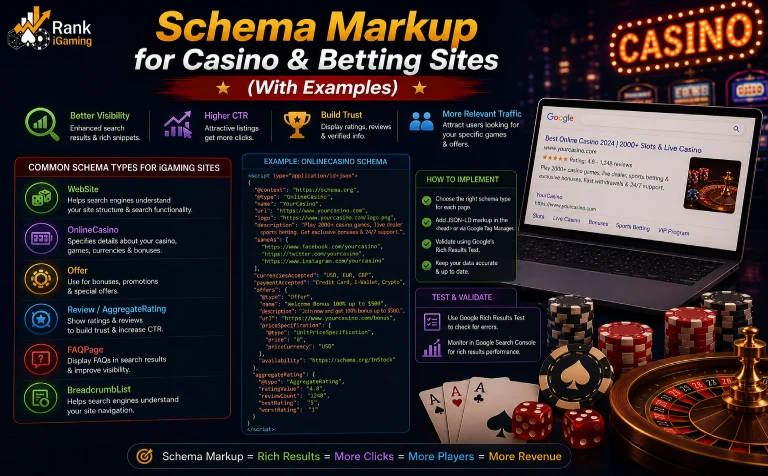
Casino schema markup notifies search engines what type of your page is: a review, article, list of questions, licensed firm, etc. Machines don’t guess well, and you don’t want them guessing in a field so intensely scrutinized as gaming.
One thing upfront, most schema guides you may find are now outdated as of May 2026, FAQ rich results are fully gone from Google Search. But the markup still matters, but for different reasons than the prior two years. We’ll walk through what has changed and what still works and provide you copy-ready code for each schema type. This is for in-house programmers and SEOs so let’s get practical and not theoretical.
Why Schema Matters More for Gambling Sites
Gambling is a YMYL (Your Money or Your Life) category, therefore Google’s computers have more work to do to evaluate and validate gaming pages than a typical blog. Three specific ways that structured data for casino websites is useful:
It disentangles a dubious category. A page on “bonuses” can be a review, a promo or a news piece. Schema tells Google what it is. Quality tools can fairly analyze the page instead of carefully doing so with the right classification.
It has the trust signals YMYL requires. Organization markup links your content to a real licensed organization. Article markup connects it to a real author. Machine-readable identity is a real distinction in a market consisting of anonymous affiliate sites, and we talked about why this is so crucial in our breakdown of how Google treats iGaming websites.
It still gets the rich results that still exist. Stars for reviews, article improvements and organization info panels are still there but FAQ dropdowns are gone. The other upgrades are worth having on casino SERPs where everything is the same.
What the schema is NOT: It’s not a cheat to ranking. Markup explains to machines what your content is. It won’t make bad content powerful. Each of the following excerpts implies that the described thing is, in fact, plainly present on the page.
FAQ Schema: What It Does Now (Post-May 2026)
This is how FAQ structure looks on a game site in 2026:
What’s gone: As of May 7, 2026, Google is no longer displaying FAQ rich results on any website, but in August 2023, these types of rich results were confined to government and health sites. Q&A dropdowns under listings are no longer available, the Search Console FAQ report was deactivated in June 2026 and API support ends in August 2026.
What remains: FAQPage is still a valid Schema.org type. Your questions and answers are still marked up so that robots (including AI search algorithms) can parse them clearly. Keep it where it genuinely describes real visible Q&A information, delete it where it was templated junk placed just to chase the old dropdowns.
Our advice: keep building true FAQ sections (players actually do search with inquiries like “Is this casino licensed?” or “How fast are withdrawals”) and keep marking them up. The structure makes it readable by machines. The content does the ranking.
Example FAQ markup for a gambling site:
{
“@context”: “https://schema.org”,
“@type”: “FAQPage”,
“mainEntity”: [
{
“@type”: “Question”,
“name”: “Is online casino play legal in New Jersey?”,
“acceptedAnswer”: {
“@type”: “Answer”,
“text”: “Yes. New Jersey legalized online casino gaming in 2013. Only operators licensed by the New Jersey Division of Gaming Enforcement may legally offer real-money casino games to players located in the state.”
}
},
{
“@type”: “Question”,
“name”: “What is a wagering requirement?”,
“acceptedAnswer”: {
“@type”: “Answer”,
“text”: “A wagering requirement is the number of times you must bet a bonus amount before you can withdraw winnings from it. Always check this figure in the bonus terms before accepting any offer.”
}
}
]
}
One requirement to follow to the letter: all questions and answers in the markup must be visible content on the page verbatim. More on why in the section about mistakes.
Review Schema for Casino & Game Review Pages
Review schema iGaming implementations are where we see the most problems and also where the reward is still real: review star snippets live in Google’s results and visibly lift click-through on review pages.
The rules that matter for gambling sites:
- The review must be third-party. You can mark up your review of a casino or a slot game. An operator cannot mark up reviews of itself; Google sees self-serving review markup as a violation.
- The rating displayed in markup must match the rating presented on the site. A 4.2 in the code and a “9/10” on the site are an incompatibility that gets markup disregarded or penalized.
- Pick a suitable itemReviewed kind. For game reviews, types like SoftwareApplication or VideoGame fit. For casino reviews, organizing is the typical choice; be aware Google is choosy about which review configurations gain visible stars, so treat stars as a prospective bonus, not a promise.
Example for a casino review page:
{
“@context”: “https://schema.org”,
“@type”: “Review”,
“itemReviewed”: {
“@type”: “Organization”,
“name”: “Example Casino”,
“url”: “https://www.example-casino.com”
},
“author”: {
“@type”: “Person”,
“name”: “Laiba Waseem”,
“url”: “https://rankigaming.com/author/laiba-waseem/”
},
“reviewRating”: {
“@type”: “Rating”,
“ratingValue”: “4.2”,
“bestRating”: “5”,
“worstRating”: “1”
},
“publisher”: {
“@type”: “Organization”,
“name”: “RankiGaming”
},
“datePublished”: “2026-07-20”
}
Note: See author block leading to the genuine author site. E-E-A-T signals and schema best practices for YMYL reviews are recognized and verifiable reviewers.
Article / BlogPosting Schema for Content Pages
Any tutorial, news story or blog post on a gaming site should be marked up using Article or BlogPosting. It’s the simplest schema type and the one that quietly supports your E-E-A-T story: it links every piece of content to an author, a publisher and a publication date that computers can verify.
{
“@context”: “https://schema.org”,
“@type”: “BlogPosting”,
“headline”: “Schema Markup for Casino & Betting Sites (With Examples)”,
“author”: {
“@type”: “Person”,
“name”: “Laiba Waseem”,
“url”: “https://rankigaming.com/author/laiba-waseem/”
},
“publisher”: {
“@type”: “Organization”,
“name”: “RankiGaming”,
“logo”: {
“@type”: “ImageObject”,
“url”: “https://rankigaming.com/wp-content/uploads/2026/03/logo-white.webp”
}
},
“datePublished”: “2026-07-20”,
“dateModified”: “2026-07-20”,
“image”: “https://rankigaming.com/path-to-featured-image.webp”,
“mainEntityOfPage”: “https://rankigaming.com/casino-schema-markup/”
}
Keep dateModified true The method of bumping the date without modifying the content is a trust degrading ruse that fools nobody’s quality systems for long.
Organization / LocalBusiness Schema for Licensed Operators
The organizational structure is where SEO and compliance meet for operators. That enables you to say, in a machine-readable form, who you are, where you are licensed and how to check that exactly for the identity queries Google asks most about gaming businesses.
{
“@context”: “https://schema.org”,
“@type”: “Organization”,
“name”: “Example Casino Ltd”,
“url”: “https://www.example-casino.com”,
“logo”: “https://www.example-casino.com/logo.png”,
“sameAs”: [
“https://www.linkedin.com/company/example-casino/”,
“https://x.com/examplecasino”
],
“contactPoint”: {
“@type”: “ContactPoint”,
“contactType”: “customer support”,
“email”: “support@example-casino.com”
}
}
Operators with real, land-based locations may augment this with the LocalBusiness markup (address, geo, and opening hours). For online-only brands, keep it clean. Faking local business signals is a known spam trend in this area and will be treated as such. Organization markup should be managed by affiliates and agencies too. Ours ties all of the articles on our site back to the same validated entity which is part of the technical foundation within our casino SEO services.
How to Test Your Schema
Two free tools:
Google’s Rich Results Test (search for “Rich Results Test” or go to search.google.com/test/rich-results). Paste a URL or code and it will show what rich results the page is eligible for. In June 2026, this tool eliminated FAQ support as well as the rich result itself, so don’t panic when FAQ markup no longer displays there; that’s normal.
validator.schema.org (The Schema.org Markup Validator) This verifies whether your JSON-LD is syntactically valid against Schema.org itself, regardless of Google’s rich result support. Use this for FAQ markup and any sort of Google tool that we are no longer reporting on.
Test on the live rendered page not the code snippet. Gambling sites favor JavaScript-heavy templates and schema that’s inserted client-side occasionally never reaching the crawler. While in Search Console, examine the enhancement reports monthly; schema breaks silently when templates get updated.
Common Schema Mistakes on Gambling Sites
The patterns evident in almost every technical assessment we conduct via our iGaming SEO services:
- Marking up stuff that is not displayed on the page FAQ answers in the code that don’t show anywhere on the page, ratings in markup with no rating visible to users. That’s the quickest road to a structured data manual action and gambling sites receive little benefit of the doubt.
- Required fields are missing. a review without a review rating. an article without an author. an organization without a URL. Incomplete markup is silently disregarded, so you carry the code weight with none of the benefit.
- Review markup that serves self-interest. Operators designating their testimonials as reviews. And especially in commercial niches like this, against norms.
- Old FAQ schema bloat. In 2021, thousands of templated pages still have similar trash FAQ blocks appended to chase dropdowns that no longer exist. Keep FAQ markup where the material is actual, strip it where it was never anything but a SERP gimmick.
- Conflicting schema on the page. Page code rating 4.5 vs 3.8 old date published. Refreshed content. The license claim in the organization markup footer does not support it. Machines check now. If it’s not consistent, it looks like a lie.
- No schema on money pages whatsoever. The blog receives full markup, and the reviews and comparison pages are left blank. Prioritize pages that make money first.
FAQ
Q: Does casino schema markup directly improve rankings?
A: Not directly. Schema isn’t a ranking criterion by itself, it helps Google understand and categorize your pages and earns qualified rich results like review stars. The ranking impact is indirect: better understanding, better presentation, and increased click-through on the ranks you have.
Q: Is FAQ schema still worth adding to a gambling site in 2026?
A: Yes, with caveats. There are no dropdowns for anyone as FAQ rich results disappeared from Google Search in May 2026. But the FAQPage markup is still valid, still retains your Q&A material machine-readable for search and AI algorithms, and costs nothing to maintain while the content is real. An FAQ schema gambling site setup needs to have actual viewable inquiries and nothing else.
Q: Can a casino mark up its own player reviews with review schema?
A: No, Google considers self-serving review markup (an entity marking up their own reviews) a policy violation. Third party review content, e.g., an affiliate or media site reviewing a casino or a game should have a review schema.
Q: Which schema type matters most for a casino affiliate site?
A: Look at schema on review pages, Article/BlogPosting guidelines organization-wide and the FAQ page on actual Q&A content, in about that order of influence. Review pages are typically money sites and review snippets are one of the rich results still shown.
Q: How do I know if my schema is working?
A: Use the Schema.org Markup Validator to validate your syntax, the Google Rich Results Test to test your eligibility for rich results, and the enhancement reports in Search Console to monitor for issues that may appear over time. And remember the tools test the rendered page, so any JavaScript injected markup needs to be checked on the live URL, not the template.
Get a Technical SEO Audit for Your Gambling Site
Schema is only part of a technological foundation that also comprises crawlability, rendering, site structure and Core Web Vitals. Weakness in any layer costs ranks in this sector.
We’ll evaluate your whole technical setup, flag every broken, missing or hazardous piece of markup and provide you a prioritized patch list that your dev team can act on.
Get your technical SEO audit →